Error message

The page you were looking for may have moved we have provided a search based on the url you were trying to reach.
Raw Open to Web Corporate Documents Videos

Equinor

Statoil to Equinor - Transitioning for a Low-Carbon Future

Equinor

Equinor, originally founded as Statoil in 1972 upon the discovery of substantial oil deposits on Norway's continental shelf, transitioned into a publicly traded company in 2001 with the Norwegian government retaining majority ownership. The company developed its expertise in the extraction of fossil fuels from challenging deepwater locations and emerged as a significant player in the global oil market. Recognizing the finite nature of the Norwegian oil fields and increasing concerns regarding climate change, Statoil initiated a strategic shift to transition to what they believed to be a low-carbon future. This involved a rebranding to Equinor in 2018 to reflect its broader energy focus. Equinor's strategy embraced both maintaining its oil business with reduced carbon emissions during extraction and sequestration and expanding its renewable energy portfolio. 

Despite these efforts, Equinor faced substantial challenges. Many stakeholders viewed the hybrid model skeptically, contrasting the reliable and high-margin oil sector with the innovative but lower-margin renewables sector. Environmentalists and ESG investors doubted Equinor's commitment, and others highlighted the dissimilar business nature and the complexity of reconciling these within a single corporate structure. After the 2022 Russian invasion of Ukraine, Equinor’s hybrid strategy was scrutinized as the company increased natural gas production to support Europe’s energy security, earning record profits and raising questions about how the company would invest its windfall.

Case details

Sponsor(s)

This case study was created in support of the Yale Program on Stakeholder Innovation and Management and is available to businesses and accredited academic institutions for free. 

Credits

Project Editor
  • Jean Rosenthal Case Study Research & Development Team, Yale School of Management
Case Supervision
  • Jon Iwata Practice Leader, Program on Stakeholder Innovation and Management, Yale School of Management
  • Edward A. Snyder William S. Beinecke Professor of Economics and Management
  • Jaan Elias Director, Case Study Research & Development Team, Yale School of Management
Video Producer/Editor
  • Greg MacDonald Senior Associate Director for CRDT Media & Technology, Case Study Research & Development Team, Yale School of Management
Equinor Video Interviews
  • Helge Lund Former CEO Statoil 2004-2014
  • Eldar Saetre Statoil/Equinor, Former CEO 2015-2020
  • Anders Opedal Equinor President and CEO November 2020 to present
Additional Equinor Interviews
  • Pål Eitrheim EVP New Energy Solutions (NES)
  • Einar Lie Professor of Economic History, U. of Oslo, Norway
  • Stig Lægreid Employee Member, Equinor Board of Directors
  • Jannik Lindbæk EVP Communication
  • Philippe Mathieu EVP Exploration and Production, former Senior Vice President Corporate Strategy,
  • Bård Glad Pedersen Media Relations
  • Jon Erik Reinhardsen Chair, Equinor Board of Directors
  • Torgrim Reitan EVP and CFO
  • Irene Rummelhoff EVP MMP, former EVP New Energy Solutions (NES).
  • Siv Helen Rygh Torstensen Executive VP and General Counsel, Legal & Compliance former Head of CEO office
  • Svein Skeie EVP and CFO
Special Thanks
  • Reidar Gjærum Former EVP and Chief Communications Officer of Equinor
Photo Credit
  • Hywind Scotland turbines at Buchan Deep, August 2017, (c) Equinor

Introduction

In 2017, Equinor, one of the world’s largest oil companies, announced that it was planning to expand its renewable energy business while maintaining its oil business with low-carbon solutions like carbon capture and sequestration (CCS). In 2020, the company created an ambitious roadmap to get to net zero in terms of its business by 2050, a commitment greeted with skepticism by some environmental groups, who doubted the company’s sincerity and the ambitiousness of its plans.

Equinor began life in 1972, after substantial oil deposits were discovered on the continental shelf of Norway. With the Norwegian government as its owner, the company, eventually named Statoil, developed expertise in extracting fossil fuels from deep-water locations. Statoil entered the public markets in 2001, with the Norwegian government remaining as its majority stockholder The company was cognizant that Norway’s continental shelf would eventually be depleted, and it merged with another Norwegian energy firm in 2007 as they both developed international operations within oil and gas. Over time Statoil developed strong capabilities in building and managing complex stakeholder relationships: with the government, other shareholders, the citizens of Norway, customers, suppliers, and employees. Statoil’s Norwegian fields coupled with its subsequent international operations made it a power in the global oil market.

However, in the 2010s, Statoil’s management became concerned about climate change, including would impact the oil and gas market over time. Statoil began planning for a low-carbon future. The company announced it would explore ways of extracting oil and gas in a less carbon-intensive way as well as build a substantial renewables business. The moves, the company management believed, would help maintain the company through a transition to a new energy future. But numerous stakeholders found fault with this hybrid approach.

Some argued that the revenue from oil had built the Norwegian economy and the country had benefited from fossil fuels more than any other outside the Persian Gulf. Margins from fossil fuels remained strong, and the returns from renewables were much smaller. Oil and gas would continue to be the dominant form of energy for some time to come, and many giant oil companies were competing with Statoil. For the company to lose focus and investment muscle to these competitors could imperil the company’s level of profitability and impact as Norway’s corporate champion.

Throughout the years of its transition to a diversified business model, Equinor had to gain the support of a complex dynamic of stakeholders, from the Norwegian government and shareholders to employees and customers. To reflect the strategic shift, after careful consideration and management attention, the company changed its name from Statoil to Equinor in 2018.

Substantial portions of the Norwegian population were concerned about climate change – the country had the highest number of electric vehicles per capita of any country in the world. And the most ardent environmentalists, who held that the only good barrel of oil was one that stayed in the ground, argued for a phase-out of all oil production towards 2023. In addition, ESG investors and environmental advocates were well aware of other energy companies that had dipped their toes into the renewables market only to withdraw when they hit obstacles.

Investors, in general, preferred “pure play” companies to hybrids. Renewables were different from oil businesses in some fundamental ways. Renewables firms tended to be nimble, high-tech operations focused on innovations, whereas oil and gas companies were often seen as reliable, lumbering giants focused on high margins and cost control. How could management reconcile the demands of these dissimilar businesses without losing its strategic focus? How could Equinor develop the skills and networks required for the renewables market after its workforce had spent decades perfecting their knowledge of the oil business?

The dissimilarity of the businesses had persuaded many other fossil fuel companies to shy away from the hybrid approach. Ørsted, the Danish oil and gas company, decided to sell off all of its fossil fuel holdings by 2024 to concentrate on renewables, while ExxonMobil had doubled down on oil and gas. Other fossil fuel companies like Shell and BP had made feints toward building renewable businesses with only mixed success.

The Russian invasion of Ukraine in 2022 renewed focus on Equinor’s commitment to the hybrid strategy, as the company and its stakeholders broadly discussed how to balance the energy trilemma – sustainability, security and affordability. Equinor found itself a key player in ensuring Europe’s energy security during this period of hostilities. It increased its production of natural gas to help fill the EU's energy gap left by declining amounts bought from Russian suppliers. While Equinor maintained that it was continuing on its announced roadmap to net zero, environmentalists in Norway and abroad raised alarms about the increasing production and the unusual level of profits from the company's fossil fuel business. How could Equinor’s management continue to make its hybrid strategy credible to stakeholders in this new environment?  

Continuing to state that it would make its hybrid approach work, Equinor continued to concentrate on working with stakeholders to find and show synergies between its oil business and renewables, develop new skills among its workforce, and make strategic investments in renewable businesses across the globe. How would they manage the new challenges introduced by the strategy shift, most prominently changing their culture and developing new stakeholder relationships while dealing with the impact of the increased demand for natural gas in the new environment?

Norwegian Oil Policy

When oil was discovered off the coast of Norway in the late 1960s, the Norwegian government quickly moved to set up mechanisms to sell leases to and collect revenues from companies looking to explore and develop this resource. Within a year, the government also created a state-owned oil and gas company to develop expertise in the extraction and sale of petroleum products and to provide employment for the Norwegian people. The mission of the new company, later named Statoil, was to help Norway do more than just collect revenues from the ownership of a resource, but to also participate in the downstream gains that could be realized from what seemed likely to become a huge part of the country’s economy.

Norway's Ten Commandments of Oil Policy

In 1962 Phillips Petroleum gained permission from Norway to explore for oil and gas on the Norwegian Continental Shelf (NCS). In 1969, Phillips discovered one of the largest offshore oil fields in the world – a field named Ekofisk that was located in the Norwegian portion of the North Sea.

400ekofisk_complex_press-photo3_conocophillips1440x720.jpg

The Enormous Ekofisk field on the NCF was discovered in 1969.  

Credit: Petroleum Norway

This discovery started a boom in NCS oil and gas fields as more and even larger fields were discovered on the NCF over the next decade. To establish national guidelines for this new asset, in 1971 the Storting (Norwegian parliament) approved a national petroleum policy. The basic principles of the policy included national control, the development of a national oil industry, a requirement that all producers bring all petroleum ashore onto Norwegian soil, and the establishment of a state-owned oil company. The government policy also established that the state was to have 50% ownership in every production license, generating funds to compensate the country for the extraction of its resources. The policies adopted by the government were summarized as “The Ten Commandments of Norwegian Oil Policy" and became known internationally as the “Norwegian Model.”

Norway’s entry into the oil market in the 1970s turned out to be financially fortuitous. During the next decade, the Organization of Petroleum Exporting Countries (OPEC) orchestrated dramatic increases in the world price of oil – the price of a barrel of oil went from $2.96 to $37.10 in just over ten years (though oil prices declined during the 1980s).  While Norway was not part of the cartel, it benefited greatly from the “umbrella effect” of being able to charge higher prices for its energy.

In the decades after the discovery, the petroleum sector became Norway's largest income source, measured in terms of value-added, government revenues, investments, and export value. The oil and gas revenue stream grew to be around a third of Norway's GDP and a fourth of its annual general income. Oil and related industries employed around 300,000 individuals in Norway, 5.5% of the country’s population.[6] The government directly derived oil revenue from three sources: taxes on oil extracted, direct ownership of a portion of various oilfields (SDFI), and dividends from state-owned enterprises engaged in the oil and gas business. The tax revenues supported the country's current operations, while the revenues from ownership of oilfields and dividends from state-owned enterprises went to Norway's sovereign wealth fund, the Norwegian Pension Fund Global (NPFG) or Norwegian Oil Fund.[1]

Norway's Net Government Cash Flow from Petroleum Products (NOK millions)

small-24545-net-government-cash-flow-from-petroleum-activites_0.png
Credit: Statistics Norway

Avoiding the “Dutch Curse”

For many countries, a sudden influx of huge amounts of revenue from an unexpected source like the discovery of oil could paradoxically lead not to prosperity, but to negative consequences, including financial and political instability, corruption, and degradation of traditional cultural values. To avoid this problem, initially labeled in a 1977 article in The Economist as "the Dutch Disease,"[2] Norway established a special fund in 1996, the Norwegian Pension Fund Global, later known as the Norwegian Oil Fund or the Norwegian Bank Investment Management (NBIM), to hold and invest a significant portion of its petroleum revenues for future public pension obligations. 

Many observers of Norway's overall success with its oil riches credited the cultural attributes attributed to the country and its neighboring countries. As described in a 2004 Slate article:

Norway has pursued a classically Scandinavian solution. It has viewed oil revenues as a temporary, collectively owned windfall that, instead of spurring consumption today, can be used to insulate the country from the storms of the global economy and provide a thick, goose-down cushion for the distant day when the oil wells run dry.[3]

The NBIM’s existence and growth came from Norway’s long-term view of its petroleum revenues. Each year since then, the government added to the fund the revenues derived from the oil fields, with the plan of withdrawing only expected earnings from the fund and leaving the capital intact to benefit future generations. To accomplish this goal, the government instituted a spending rule that allowed the country to take only 4% of the NBIM’s assets each year to help fund the country’s current operations. By 2020, the NBIM had become the largest sovereign wealth fund in the world, valued at $1.2 trillion, roughly $250,000 per citizen of Norway.

The Norwegian parliament set the fund’s investment policy, while the NBIM, an arm of the country’s national bank, ran the day-to-day operations. The fund was managed in a highly transparent manner with far more stringent investment guidelines and reporting requirements than any other country's sovereign wealth fund.

Norwegian Society

Norway had been described as a "prosperous bastion of welfare capitalism, featuring a combination of free market activity and government intervention."[4]  Norway ranked at the top of one measure of overall national success, measured by the Human Development Index (HDI), a composite statistic incorporating life expectancy, education, and standard of living.

Most observers argued that oil wealth had not greatly changed Norwegian society and culture. While some people had become wealthy from the oil industry, the country remained one of the most egalitarian in the world. One measure of income inequality is a country’s Gini index, a summary measure that ranges from 100 (most unequal) to 0, most equal. According to the World Bank, in 2018, when the United States Gini index registered 41.1, the value for Norway was 27.6. In another measure, in Norway, the top ten percent of income earners received 22.2 percent of the country’s total income. In the United States, the top ten percent drew 30.7 percent of all income. 

Norwegian society placed a high value on equality, openness, and transparency, and expected the same from its government and businesses. Observers also cite the high esteem of nature and outdoor life. In one example, Norwegian law (Allemannsretten, or every man's right) allows individuals "the freedom to roam" the countryside - to hike and forage on any uncultured land, such as woodlands, meadows, rivers and lakes, no matter who owns the land, following only a few basic rules.[5]

One example of the country’s approach to transparency and openness was that Norway provided public accessibility to income information about every individual.[13] Started in 1814, the "skatteliste," or tax list, was published annually, originally in a book available at local libraries. Since 2001, the data has been published online in a searchable database. (The high level of searches led to a requirement that those searching include their own tax numbers, so individuals can see who had searched for them.[6] 

Some observers likened Norwegian culture to a shared Scandinavian cultural trait captured by the concept of “Janteloven” or Jante Law. The term was based on a fragment of a 1933 “scathing” novel by the Danish-Norwegian author Aksel Sandemose. Described as a particularly difficult individual, Sandemose articulated “Ten Commandments” or tacitly accepted rules of behavior in the fictional town. The supposed social norms of Jante required citizens to not try to stand out from the crowd or strive to be better than anyone else. Although Sandemose novel was satirical, many saw some truth in this parody of the culture. Some observers even credit this social attitude with maintaining Norway's egalitarian society, although there are questions as to whether it perhaps discourages innovation or drive for excellence.[7] 

Footnotes

  1. ^ The Government's Revenues, Norwegian & Petroleum
  2. ^ ‘The Dutch Disease,’ The Economist, 26 November 1977, pp. 82–83.
  3. ^ Daniel Gross, “Avoiding the Oil Curse,” Slate, October 29, 2004.
  4. ^ Best Countries for Business, #8 Norway, October, 2011
  5. ^ The Norwegian right to roam the countryside, Publikasjon, June 2020. 
  6. ^ Dorothee Enskog, The Nordics’ wage transparency experiment, Rethink Quarterly, January 2023.
  7. ^ The Law of Jante, Paris Review, February 2015, https://perma.cc/7CDR-8U3J 

Statoil

Founding

In 1972, as part of its national petroleum strategy, the Storting (Norway’s parliament) created the “Den norske stats oljeselskap A/S” (Norwegian State Oil Company), a private limited company owned by the government to participate in the developing petroleum industry on the Norwegian Continental Shelf. The decision received support across the political spectrum in Norway. The name was difficult to communicate, especially as the company ventured into consumer markets. The company soon adopted the far simpler moniker, ‘Statoil.’  

In chartering a state-owned oil company, Norway’s politicians realized they were taking on considerable risk. Even if the fledgling Statoil managed to become a fully functioning oil company, the more direct avenue to state revenue would have been to rely on taxing the output of international oil giants that took on the technologically difficult task of extracting oil from the Norwegian Continental Shelf. Although Norway did tax income from developments in their territorial waters, by entering the petroleum industry directly, it was forgoing certain profits to create “an instrument for the realization of the state’s industrial policy within the petroleum sector.” The early leaders of Statoil also realized developing the ability to extract oil was not enough; the company would have to be vertically integrated as were most of the major oil companies. Statoil’s ability to turn a profit would depend on having market power in the refining and sales part of the value chain as well.

cr-gina krog-71cr-6c1072446e4f9f80a8308cb3c7827a.jpg.ncefpc7vmqupkfvhsaka.8wrzg53u0x.jpg

Gina Krog Field, began production in 2017. 

Credit: Equinor (c)Equinor

Coming up to speed in oil extraction was not an easy technological task. The national government stepped in and made the undertaking easier by requiring international oil companies to take on Statoil employees as part of their licensing agreements. Therefore, Statoil staff were embedded within large oil companies like Mobil with the same rights and obligations as the company’s own employees, including the opportunity to take training courses. In time, Statoil built its own technological expertise, matching and eventually surpassing other oil companies in its ability to build and operate offshore oil facilities in the harsh North Sea environment.

The government gave Statoil preference in winning leases to new oil fields over its foreign competitors. Nonetheless, the company relied on state support for its first eight years of existence, piling up massive deficits. The reliance on state largess made the fledging company something of a political football during its first years, as legislators sought to have the company benefit their own constituents.

The political considerations varied according to the issue, but critics in the Storting assailed the company on everything from the location of infrastructure components to concerns about how the company was impacting traditional industries like fishing, to environmental concerns about sea birds.

The debate around Statoil centered around key questions: to what extent should the company make allocation decisions based on political considerations? Or should it prioritize criteria for commercial success as an ongoing business?  The company itself promoted the idea that commercial criteria should control its actions, but achieving that goal required attention to the complex stakeholder interactions involved, particularly between the government as owner as well as the representative of the people of Norway, the political interests of elected officials, and the goals of company management.

The political debate eased in the 1980s as Statoil began making profits and paying dividends. The company had become a successful operator of offshore wells and managed to build other parts of the petroleum value chain, including refining and sales capabilities. Headquartered in Stavanger, Statoil employed thousands of Norwegian citizens on its oil rigs and in other parts of its operations. The Norwegian government’s bet on creating Statoil appeared to have paid off. Beyond the country's direct profits from Statoil's operations, Norway became the home of major portions of the petroleum value chain, as well as subsidiary industries such as engineering and construction.

Dramatic Changes

Having enjoyed success through most of the 1980s and '90s, Statoil faced a changing petroleum industry as the century came to its close. The Norwegian Continental Shelf was showing signs of depletion. No new oil finds had been registered after 1990, and existing reserves were being drawn down. Internationally, the price of oil had plummeted. Large oil companies were merging, such as Exxon with Mobil and BP with Amoco, creating a tier of "supermajor" oil companies far larger than Statoil. In response, the Norwegian government and the leadership of Statoil agreed to significant changes, including the internationalization of Statoil's petroleum sources, partial privatization, and a merger of state-owned companies.

Internationalization represented something of a break with Statoil’s traditional mission to be an instrument in the exploitation of the oil finds on the Norwegian Continental Shelf. To be sure, the company had engaged in significant international operations before the late 1990s, as the company sold its wares on the global market. But as the decade came to a close, Statoil began to also compete for new leases across the globe. Observers argued that the move represented a new understanding of the company’s identity. Rather than being just a tool to develop a particular oil field, one historian of the company noted that Statoil “saw itself first and foremost as a technology company, driven primarily by the purpose of mastering, developing, and deploying technological and operational competences.” [1]  Supporters argued that allowing this technological expertise to wither away as Norway’s national oil fields depleted would be wasteful. Furthermore, it would harm those enterprises in Norway that had developed to support the oil industry.

A further break with Statoil’s traditional mission came in 2001, when the government put 17% of the company’s shares into the public markets. (Over time, the government’s share of the company would dip to 67%.) Even though the government continued to hold the majority of the ownership, the non-government shareholders created a new stakeholder group with unique interests and opinions.

The IPO represented a considerable change in the relationship between the Norwegian government and the company. While political pressures on the company had abated somewhat, Statoil’s entry into the public markets made the commercial imperatives of the company clear – to develop oil resources throughout the globe for the benefit of its shareholders. As a historian of the company observed,

With partial privatization and listing on the stock exchange, the company’s profits would in reality also become the state’s foremost objective in owning the company.… Although the state retained a majority share in Statoil on the political premise of keeping Statoil’s strategically important head office and research and development (R&D) activities in Norway, the state’s overarching objective became primarily financial: to secure a long-term financial return on its shareholding in Statoil. It manifested a more professional ownership role for the state, in which it refrained from political micromanagement and instead aimed for long-term, predictable ownership that provided stable conditions for Statoil’s further development.[2]

Statoil further reinforced its position as an international oil firm through a merger with the oil and gas assets of Norsk Hydro in 2006. Like Statoil, Norsk Hydro was a firm partially owned by the Norwegian government. It also built offshore facilities for the extraction of oil and gas (as part of a larger business portfolio). Norwegians initially had considered the competition between the two firms as a way of encouraging each firm to improve its own operations. Over time, each firm had developed a distinct culture: Norsk Hydro, the older of the two firms, was seen as a conservative steward of assets, while Statoil was considered its more technologically advanced, risk-taking rival. With both firms competing for international leases, analysts outside Norway wondered why the two companies continued to exist separately while the rest of the industry had become much more concentrated after the merger wave of the late 1990s. By 2006, the firms and the Norwegian government saw the advantages of combining their efforts, and a merger was announced. 

The merger further clarified the relationship between Statoil's long-term goals and government policies. Norway's prime minister Jens Stoltenberg said, "Norway’s oil and gas industry should thrive internationally and not live or die on the Norwegian shelf." [3] In a news release, Helge Lund, then President and CEO of Statoil, described the goal of the merger as "to form a national champion with its sights set beyond the dwindling oilfields of the North Sea." He added,

This is a historic milestone. The time is right for one strong Norwegian-based energy champion. We are creating a stronger and more competitive company. Combining the best of both organizations, we will significantly improve our competitive position internationally and promote the long-term vitality of the Norwegian Continental Shelf." [4]

In 2008, Statoil was completing the organizational changes required by its merger with the oil and gas facilities of Norsk Hydro, becoming one of the largest offshore gas and oil companies. It had expanded its oil and gas operations internationally, including explorations of oil and gas licensing offshore in Brazil and in other countries. It had invested in Canadian oil sands and U.S. fracking operations. Lund recalled the strategy that was in place:

Strategy development during my start as the CEO was really about maximizing value from the Norwegian continental shelf, because that was the whole reason why the company was established in the first place. And by that, I mean maximizing shareholder value, but of course, also to create value for the country in many other dimensions. The second strand of the strategy was to use the capabilities, the scales, and the technology that we had developed over many decades to also create value with oil and gas outside Norway.

The merger propelled Statoil into the next league of international oil companies. The merger raised the company’s reserves and production by 50 percent, grouping it with majors like Total, ConocoPhillips, and Lukoil and big national oil countries like Petrobras and Rosneft. The gap between Statoil and the supermajors was still large, but as the world’s biggest offshore operator, the company’s international prestige had grown considerably. By 2015 the company had 23,000 employees and activities in 36 countries, a stock market value of NOK 417 billion ($55 billion), as of Jan. 9, 2015, and a history as one of Norway’s most important tools in the recovery of petroleum resources on the Norwegian continental shelf.[5] Statoil was also a very important player in Norway with supplier stakeholders in its role as a customer of other Norwegian businesses. The company bought goods and services worth NOK 127 billion ($17 billion) from Norwegian suppliers in 2013.[5]  


Footnotes

  1. ^ Statoil to Merge with Norsk Hydro oil and gas operations, Reuters, 2007
  2. ^  Marten Boon, National Champion: Statoil and Equinor since 2001, Utrecht, University, 2022,
  3. ^ Statoil to Merge with Norsk Hydro oil and gas operations, Reuters, 2007
  4. ^ Hydro's Oil and Gas activities to Merge With Statoil, Statoil Press release.
  5. a, b Statoil’s big dilemma: should it continue to go for oil and gas – or transform itself into an energy service provider? Energypost EU, March 2015.

Statoil’s Place in Norway

The Norwegian Public

Statoil's relationship with the people of Norway was deep and complex, extending beyond the revenues it provided to the country. According to historian Einar Lie, many Norwegians saw Statoil as Norway’s ‘national champion’ - “a company that exemplified Norway's nation-building and the values of the state in the world.” Statoil was not just the company with the largest revenues in a small economy, but it was a creation of the Norwegian state, providing a model for other small countries with exploitable fossil fuel deposits. The international prominence of Statoil was a source of national pride. Many of Statoil’s Norwegian employees saw a dual allegiance in their job – not just making the company successful but also fulfilling its perceived societal purpose and its representation of Norway’s society.[1]  

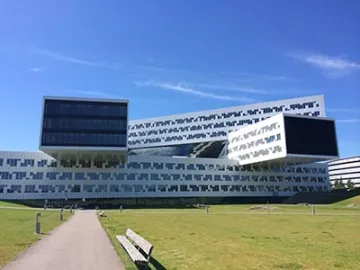
smaller-statoil_fornebu_img_4600 (1).jpg

Equinor's office building in Fornebu, outside Oslo, Norway. 

Credit:  Erlend Bjørtvedt (CC-BY-SA)

With Statoil’s image as a national champion, its activities were always of interest to the Norwegian people and press. As Jannik Lindbæk, Senior. VP of Corporate Communications noted, "We can't stay below the radar - that's not an option. The press has always been interested in the company and its internal workings."

Statoil's goals of openness and trust were not always comfortable for the company. Statoil’s decisions were dissected in the press, sometimes to the company’s embarrassment. There were frequent leakages of internal information, and Statoil’s labor conflicts were fought out in national media rather than corporate boardrooms.[1]  In one infamous example, the Norwegian newspaper Dagens Næringsliv (DN) [in English: Today's Business] in 2020 published a 16-page report detailing Equinor’s large losses in its North American investments, predominantly from write downs after the sharp decline in oil prices from late 2014 and some questionable spending in the U.S., all events from nearly a decade earlier. The revelations became a national scandal.[2] 

Statoil’s leadership had promoted transparency in its operations, and Statoil's then-CEO Helge Lund saw a trend in the larger society that expected all companies to be more open with their intentions. Lund made a speech in 2012 at a major oil conference promoting the values of openness and transparency as the new currency of trust. Although there was some pushback from other oil companies at the time, in a few years the idea was generally accepted. As Lund looked back at the impact of this approach on Statoil, he said, "By exposing ourselves to critics, to NGOs, and others, we simply become a better company."

New Governance Structure

Statoil’s IPO in 2001 changed the formal relationship between the national government and the company. Before the IPO, the Board and CEO of Statoil had a direct reporting relationship with the Norwegian Ministry of Petroleum and Energy (and by extension, the Storting). Even though the government retained a lion’s portion of the shares after the IPO, the government’s role in Statoil’s governance was channeled through its position as majority shareholder and its role as a member of the Nomination Committee, which in turn suggested the composition of the board. 

Jon Erik Reinhardsen, the current chair of Equinor’s board, pointed out that the company’s board operated independently and made decisions on behalf of the company that made sense for the company's strategy, well-being, and development. All members of the board come from outside the company and the government – except the three elected employee representatives, as required of all Norwegian businesses. As Reinhardsen described the board, “We elect the CEO, approve strategy, control, monitor, and approve. So, it's an oversight role. We approve all policies.  Our main mandate from the government at the time of the transition [to a publicly traded company] was to maximize shareholder value over time.”

Board members were recommended by the Nomination Committee, an independently elected group, separate from the board. The government (represented by the Ministry that held the ownership of the shares in Statoil/Equinor) was one of four representatives on the committee. The committee recommended external Board candidates to the corporate assembly, a larger group elected by shareholders, who then voted on who should serve.

Three board members were elected by the company’s employees. Their compensation and responsibilities were the same as those for shareholder-elected board members, and they were expected to consider all issues. Many served in long-term positions on the board. For example, one employee representative, Stig Lægreid, served on the Board for over 20 years. 

Besides revising governance procedures, Statoil’s privatization caused the Norwegian government to reconsider its relationships with all of its state-owned enterprises (SOEs). While Statoil was the largest and most profitable, the state of Norway partially or completely owned 71 companies. In order to boost confidence in all SOEs, the Storting formulated a list of ten principles that the government pledged to follow in the operation of these companies:

  1. Shareholders are treated equally.
  2. The state is transparent about its ownership in SOEs.
  3. Shareholder decisions are taken at the General Meeting.
  4. The state formulates objectives for SOEs and the Board is responsible for their realization.
  5. Capital structure shall be adapted to the state’s objectives and the position of the SOE.
  6. Board compositions shall be marked by competence, capacity and diversity, reflecting each company’s character.
  7. Wages and incentives are reasonable and promote value creation in SOEs.
  8. The Board shall ensure independent control of the company’s management on behalf of the shareholders.
  9. The Board formulates a plan for its own functioning and proactively develops its own competences. The Board’s functioning shall be evaluated.
  10. SOEs must be aware of their corporate social responsibility.

Public and Governmental Shareholders

The government’s stance regarding its relationship with Statoil had given public shareholders confidence in the management of the company. Equinor CFO Torgrim Reitan, said, “From the time of the privatization, the government has acted on a very arm's-length basis, taking a very professional investor approach. The state has always worked to give us the same tools and the same freedom as other companies, while following and governing with the same resolution as a public shareholder.”

The ownership structure did create some distinctions between Statoil and a firm that was completely owned by public shareholders. One difference was that the value of Equinor public shares would not include an acquisition premium, because the company could not be sold. Furthermore, if the company wanted to do a large merger using stock as the currency, the state would need to agree to be diluted. Reitan added, “I don't see it as a big hurdle, but it is more complicated for us to use our shares as a currency than it would be for a hundred-percent listed company."

Another distinction between Statoil's government-owned shares and its publicly traded shares was that, like many government entities, the Norwegian state could take a very long-term horizon in considering the company's future, while individual investors tended to focus on shorter-term returns. Having a majority owner with an infinite time horizon created stability for Equinor, but the implementation of long-term strategic planning might not align with the goals of many public investors.

Footnotes

  1. a, b Marten Boon, National Champion: Statoil and Equinor since 2001, Utrecht, University, 2022,
  2. ^ Scandal losses in US Haunt Equinor, News in English, Norway, May 2020.

Supply and Demand of Petroleum Products

Oil and natural gas extraction had proved to be a successful industry since the early twentieth century. Petroleum products dominated the industrialized landscape. Crude oil was the source of gasoline, distillates such as diesel fuel and heating oil, jet fuel, petrochemical feedstocks, waxes, lubricating oils, and asphalt. It was the most consumed energy source - petroleum and natural gas produced 68% of the energy used in the U.S.[1]

Despite its storied history, the oil industry in the 2010s was the source of much public debate. Some posited that an energy transition was underway that would lead to a world that utilized renewable sources of energy, stranding fossil fuel assets. Others pointed to the continued high demand for oil and gas and argued that the industry would continue to thrive for decades.

Oil was expensive to find and extract. Identifying a new oil field could require years of survey work. If favorable locations were identified, companies then negotiated leases with controlling governments in order to explore a given territory. Even using advanced techniques to spot promising sites, exploratory wells (costing hundreds of millions of dollars) could prove that the targeted field had inadequate supplies to begin commercial operation.

Building production rigs to exploit a find was even costlier. Land-based oil wells cost more than $3 million just to drill, and offshore oil rigs could cost substantially more, ranging from $200 million up to a billion dollars. The largest offshore rigs could house up to 100 employees who would live on the platform for weeks at a time. The time from the purchase of a lease to the first production could be as much as 10 years.[2]

In addition to the high cost of production, oil extraction also had high ongoing risks. As an extreme example, the 2001 explosion of the Deepwater Horizon oil rig in the Gulf of Mexico caused deaths and environmental damage, costing BP over $65 billion for cleanup and other costs.

The global amount of oil reserves was difficult to estimate. A number of well-known oil fields were being depleted. However, in the 2000s, various oil companies began to deploy techniques such as fracking and the exploitation of oil sands to extract oil from fields that had been considered depleted or commercially unviable, greatly increasing the potential amount of oil that could be extracted worldwide. From time to time, severe supply shocks had roiled the market whether from geopolitical jolts such as war or from natural disasters such as weather events.

sized-statistic_id262858_opec-oil-price-annually-1960-2023.png

OPEC Oil Prices

Prices changed due to a variety of factors, including changes in supply and demand, availability, geopolitical events, and natural disasters. For example, when the Organization of Arab Petroleum Exporting Countries (OAPEC) declared an embargo in 1973, there were severe supply shortages worldwide. The price of a barrel of crude oil went from $1.82 in 1971 to $11.00 in 1973. In the 2000s, multiple international worries and Hurricane Katrina's impact on oil production in the Gulf of Mexico drove prices up in 2005; reduced demand during the 2008 global recession drove prices down.[3]  

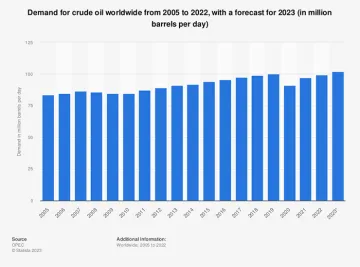
Global demand for oil and gas had been steadily increasing in the 2000s. Even as developed countries were pushing alternatives to fossil fuels, developing countries, especially China and India, were rapidly boosting consumption as they industrialized. The continued demand meant that although there were dips in the international price of oil, it had been on an upward trend since the late 1990s, and oil extraction companies were overall highly profitable. Nonetheless, the price of petroleum was volatile, and with oil as a commodity, no individual company had control of the market. As oil is moved to its destination by tankers, ownership and price might change multiple times before the ships reached their destination. The crude oil price per barrel went from $12.28 in 1998, then up to $94.10 in 2008, and down to $40.76 in 2016. [3]

sized-statistic_id271823_global-crude-oil-demand-2005-2023.png

Worldwide Demand for Oil


Footnotes

  1. ^ Energy mix, Ritchie and Roser, Our world in data.
  2. ^ Offshore oil timeline
  3. a, b Average annual OPEC crude oil price from 1960 to 2022 (in U.S. dollars per barrel). Statistica

Environmental Concerns

The fossil fuel industry faced strong pressures from authorities and groups seeking to address CO2, one of the major causes of climate change. Petroleum and gas combustion were leading sources of CO2 – a greenhouse gas (GHG) that was driving global warming. While the dangers of GHGs had been well known since the early 1990s, efforts to limit their production had been halting for the next few decades. In the 2010s, however, intergovernmental action along with new technologies were furthering efforts to limit the production of CO2.

International efforts to curb GHGs started with the Earth Summit in 1992, which resulted in the United Nations Framework Convention on Climate Change (UNFCC). A subsequent international conference held in Kyoto in 1997 led to a series of protocols (not approved until 2005) that sought to establish limits for GHGs as well as establish mechanisms to finance technologies to limit the release of GHGs. However, the United States never ratified the protocols and many countries made only half-hearted efforts to implement the agreement.

For its part, the EU made more coordinated efforts to try to curb GHGs, including an ambitious cap and trade system that collapsed during the 2007-09 financial crisis. In subsequent action, the EU adopted a target of 20% renewable energy by 2020, though GHG levels continued to increase on the continent.

While governmental efforts to curb GHGs were proving to have limited effect, in the decades since Rio, various companies had introduced new technologies that showed promise in addressing the issue. The primary emphasis of these technologies was on substituting alternative energy sources for carbon-rich fossil fuels. Renewable technologies such as wind farms, solar collectors, and hydro projects had been deployed to reduce the importance of fossil fuels in powering the electrical grid. Other technologies like electric vehicles and battery storage of electricity were being developed to further exploit cleaner energy sources and uses.

In December 2015, the nations of the world met in Paris to try once again to establish limits to GHG emissions. The resulting agreement was a legally binding international treaty, adopted by 196 parties to limit global warming to well below 2 and preferably to 1.5 degrees Celsius, compared to pre-industrial levels. The Paris Accord website noted,

"The Paris Agreement is a landmark in the multilateral climate change process because, for the first time, a binding agreement brings all nations into a common cause to undertake ambitious efforts to combat climate change and adapt to its effects.[1]

In signing the international treaty, the nations agreed to substantially reduce global greenhouse gas emissions to limit global temperature increases, review their commitments every five years, and provide financing to developing countries to mitigate climate change, strengthen resilience, and enhance abilities that would help to adapt to climate impacts. Although there were no penalties for countries that fell behind on the Paris Accord goals, countries continued to work together and report on their progress.

With ambitious goals in mind, many governments began to implement strong incentives for renewable energy. The subsidies, whether for renewable energy sources, electric cars, or cleaner heavy industries, were designed to accelerate the movement away from petroleum products. In many jurisdictions, the new technologies did not even need subsidies to be cost-effective as technologies such as solar and wind were reaching “grid parity,” meaning they were producing electricity at a cost equivalent to or below that of traditional sources. Not all of the incentives moved industry entirely away from fossil fuels, as many utilities were transitioning from coal or oil to natural gas to generate heat and electricity since natural gas produced fewer emissions than coal or oil.

Norway and Climate Change

Most Norwegians were of two minds when it came to limiting GHGs. They recognized the positive effects of the oil and gas revenues from the Norwegian Continental Shelf. At the same time, most Norwegians were strong supporters of efforts to mitigate climate change, and environmental awareness was high in the country.

Norway had been blessed with natural resources that the country’s government had been eager to protect. Norway’s many rivers and rugged geography made it possible for over 91.5 % of the country’s energy to come from hydroelectric facilities. Around 17% of the mainland and 65% of the Barents Sea were protected by national parks, reserves, or other conservation designations. The country had an official ocean policy to promote the conservation and sustainable use of marine ecosystems.

Norway had been an early mover in international forums on climate change. As early as 1989, Prime Minister Gro Harlem Brundtland led Norway to become the first in the world to set a concrete national CO2 stabilization target, aiming for the 1989 level by 2000. In a speech in 1991, she set a special CO2 tax, the first in the world. In a 1991 speech at an industrial conference, Brundtland expressed the urgency of the problem:

We cannot postpone dealing with global warming. We have enough scientific evidence about causes and probable effects to know that the costs of not acting will be very high and that a further delay of action will increase these costs even more.[2] 

The Norwegian people had followed suit; a 2020 report found that a clear majority of Norwegians thought that they have a responsibility to cut greenhouse gas emissions. Norwegians had the highest percentage of electric car ownership of any country in the world. Businesses within Norway also responded. Even Statoil had been working to reduce its carbon footprint and make its oil and gas operations more efficient and cleaner.[2]

Anders Bjartnes, editor of the website Energi og Klima, described Statoil’s dilemma in an in-depth strategic analysis. He pointed out that Statoil acknowledged the need to take drastic measures against climate change while persisting in a strategy aimed at expanding its oil and gas production globally. Bjartnes argued that the company could not forever embrace these opposing views, “where verbal concerns go in one direction while strategy and cash go in the opposite direction.”[3]

Footnotes

  1. ^ The Paris Agreement, UNfcce, https://perma.cc/3HP7-JZ5Q     
  2. a, b Statoil's Big Dilemma, Energy-Post.EU, 2015,  https://perma.cc/D34F-N4T3  
  3. ^  Most Norwegians think they have a responsibility, Science Norway. January 2020.   https://perma.cc/AX22-V5AM  

Industry Response

The strategic situation facing fossil fuel companies in the teens of the 21st century represented opposing demands. On one hand, demand for oil and gas remained high and profits considerable. On the other hand, international efforts were seeking to curb consumption and offer considerable incentives for businesses to do so. Industry leaders knew that they had to peer far into the future to determine the course of their companies as the industry had long lead times and high capital costs for new investments. The long-term strategies of oil and gas companies varied from those that doubled down on their existing business to those companies that were working to exit, to those that chose a hybrid strategy between extraction and building alternative energy capabilities.

Responses of Super-Majors

ExxonMobil

As the largest privately controlled oil company, ExxonMobil remained solidly in the oil and gas business – with only minor investments in alternative energy sources. In 2015, when critics argued that the company ran the risk of “stranding” its expensive assets in a low-carbon future, the company replied,

We are confident that none of our hydrocarbon reserves are now or will become ‘stranded.’ We believe producing these assets is essential to meeting growing energy demand worldwide, and in preventing consumers – especially those in the least developed and most vulnerable economies – from themselves becoming stranded in the global pursuit of higher living standards and greater economic opportunity… ExxonMobil believes that although there is always the possibility that government action may impact the company, the scenario where governments restrict hydrocarbon production in a way to reduce GHG emissions 80 percent during the Outlook period is highly unlikely.[1] 

ExxonMobil argued that oil and gas would continue to be needed for 30 to 50 years and efforts to replace oil and gas with renewables in the shorter term were unlikely to succeed. The company vowed to remain focused on oil and gas while working to deliver petroleum products as cleanly as possible, decarbonize production, and use carbon capture and storage to bring down emissions.[2]

In 2021, Exxon's strategy faced new challenges to its strategy when Engine No.1, an activist hedge fund, won a proxy battle to elect three eco-conscious nominees to the company's board of directors. Engine No. 1 had made a shareholder argument that Exxon did not have a viable strategy for the long term. The Engine No. 1 position appealed to several large institutional investors that were unhappy with Exxon's returns at the time. In spite of the unexpected victory, by two years later many observers said that the company's investment strategy seemed to be unaffected by the new board members. Environmental advocates opined that Exxon was continuing to focus on investments in oil and gas rather than green solutions.[3] 

Shell

Shell, the world’s second-largest private oil company, seemed to vacillate between positions. In February 2018, Shell announced it would become an “energy” company rather than an oil and gas company. At the time, Shell’s leadership argued that the energy sector was changing fundamentally, and global oil demand would peak sometime between the late 2020s to 2040, due to competition from other sources of power. What would follow would be a long decline, with those companies left holding oil assets being the losers.  Then Shell CEO Ben van Beurden put Shell’s strategy succinctly: “We won’t be sitting ducks. We’re going to adapt.”[2]

Then, in 2023, Shell seemingly backtracked on these commitments, announcing a new strategy to continue investing in oil and gas production and only selectively allocating capital to renewable energy solutions. New CEO Wael Sawan argued, “It is critical that the world avoids dismantling the current energy system faster than we are able to build the clean energy system of the future. Oil and gas will continue to play a crucial role in the energy system for a long time to come with demand reducing only gradually over time.”[4]

Mid-Size Scandinavian Companies

Smaller Scandinavian fossil fuel companies took alternative approaches to the challenge of addressing climate change and continued oil production. Some examples include:

Ørsted

Ørsted had begun as a fossil fuel company created by the Danish state during the 1973 oil crisis to develop Denmark’s North Sea oil and gas sector. It was first named Dansk Olie & Naturgas A/S (Danish Oil and Natural Gas), also known as DONG. As early as 1998 it began producing electricity from offshore wind for its retail customers. In 2006 it merged with Danish electric companies to become a diversified energy company.

Even with efforts to cleaner energy sources, Ørsted remained one of the most coal-intensive energy providers. In 2016 the Danish government held an IPO for 49.9% of its shares. After major investments in offshore wind farms, the company completely divested its oil and gas holdings to focus entirely on green energy – and renamed itself Ørsted, for the 19th-century Danish physicist Hans Christian Ørsted, who had discovered the connection between electricity and magnetism. In a short time, Ørsted became the largest offshore wind company in the world.

Lundin Energy

Lundin Energy (formerly Lundin Petroleum) was a Swedish company initially focused on the exploration and development of oil and gas on the Norwegian Continental Shelf. In 2022 it split into two companies, retaining its renewable assets while selling off its oil and gas assets. The retained renewable business became Orrön Energy, a standalone business under the Lundin Energy umbrella, with a pure-play focus on energy transition opportunities in renewable wind and hydro.

Lundin sold its oil and gas business to Aker BP, a Norwegian oil and gas company created through a merger of Aker and BP’s licenses at the Norwegian Continental shelf (NCS). The company holding the combined assets of the two oil and gas companies was named Aker BP ASA and was listed on the Oslo Stock Exchange. Aker BP became the second-largest producer on the NCF. At the time of the merger of the two oil businesses, Karl Johnny Hersvik, CEO of Aker BP (recruited from Equinor), outlined the new company's goals, "Our ambition is to create the world’s best oil and gas company with low costs, low emissions, profitable growth, and attractive dividends. We will also play an important role in the global energy transition.”[5]

Neste 

Neste was founded by the Finnish government in 1948 to secure Finland's oil supply, primarily Russian supplies. (Neste means "liquids" in Finnish.) Its core activities became oil refining and shipping. Over time it expanded to natural gas exploration and production in addition to its chemical products. It also became a retail service station brand in several countries.

In the early 2000s, Neste shifted its historical asset base from oil refining and marketing toward processing biofuels and other renewable and circular products. Its major product areas included renewable diesel produced from oils and fats; lower-emission fuels for aviation and shipping, and renewable and recycled raw materials for plastics. It successfully commercialized its patented technology to produce Neste Renewable Diesel (formerly NExBT - “next generation biomass to liquid”) a vegetable oil-based diesel. In 2016 the Finnish government dropped its share of ownership from 50% to 36%.

Neste became the world’s leading producer of renewable diesel and sustainable aviation fuel. It operated refineries in three countries and generated the majority of its revenue from renewable diesel and other renewable products. Several companies, including Volvo, Bosch, and IKEA partnered with Neste to use renewable diesel to reduce emissions and progress toward sustainability goals.[6] 


Footnotes

  1. ^ Statoil's Big Dilemma, Energypost.eu, 2015. https://perma.cc/D34F-N4T3 
  2. a, b ExxonMobil Strategy at odds with those of Statoil and Shell, 2015, Combustion Energy News, https://perma.cc/PLR5-HN5A   
  3. ^ Andrew Ross Sorkin et al, Reassessing the Board Fight That Was Meant to Transform Exxon. New York Times Dealbook, May 31, 2023
  4. ^ Jeff Brady, “Shell plans to increase fossil fuel production despite its net-zero pledge,” NPR, June 14, 2023. https://perma.cc/M9FK-2CGP
  5. ^ Merger between Aker BP and Lundin Energy's E&P,  https://perma.cc/X77R-EBQ9
  6. ^ Neste's Strategy, https://perma.cc/V2MN-5C2K 

Developing a New Plan

In the 2000s, environmental concerns about Norway’s role in producing oil and gas began percolating throughout the country’s political institutions. Even the country’s Minister of Petroleum and Energy, Terje Riis-Johansen, expressed the importance of considering alternatives to fossil fuels. And even as concerns about the environment were growing locally and internationally, Statoil’s oil and gas revenues remained important to multiple stakeholders – employees, public shareholders, the Norwegian government, the industries that supported oil and exploration and development, as well as the Norwegian public.

In 2007, following Statoil's merger with Hydro, Statoil's bylaws were amended to add “other forms of energy” to the list of the company’s approved activities.[1] After the bylaw change, under the leadership of CEO Helge Lund, Statoil began a multi-year strategy review to address what role, if any, alternative energy would play in the company’s future. Lund described the options under discussion:

There were two options that we discussed. One was that we concentrate on oil and gas to become the safest, most reliable, most effective oil and gas company, with the least emissions from our activities. And then based on that, create value and return dividends to shareholders, which they could invest in other sources of energy with the best players in that space in the energy market. So that was one strand.

The other strand was really to continue to pursue oil and gas with the same sort of ambition of improving our operations all the time, while at the same time building options within a broader set of the energy market, looking at carbon capture and renewables.

The path of divesting oil and gas was "never on the table," as one company executive put it. Although company leaders recognized that future environmental concerns could limit the production of oil and gas long before oil fields were depleted, many stakeholders still depended on the energy and revenues produced by Statoil's oil and gas resources.

Eldar Sætre, who succeeded Lund as president and CEO of Statoil in 2014, continued the evaluation process and gave it a high priority. Sætre strongly advocated for adding renewable energy and carbon capture to the company’s oil and gas business. After long discussions, Statoil’s executives decided on a long-term strategy of becoming a "broad energy company," developing a portfolio of multiple energy options. They resisted the term "hybrid," since they looked to develop multiple energy options, balancing its investments in oil and gas with investments in renewables and carbon capture technology.  

By 2017, the company's climate roadmap had taken shape. The strategy set goals for investment decisions in both renewables and oil and gas. In addition, the plan set goals for carbon reduction, but it did not attempt to predict specific activities to reach those goals. Overall, the plan was designed to meet the goals of the Paris Agreement while sustaining the company. Pål Eitrheim, who at the time led Equinor’s upstream business in Brazil, remembered some of the factors that had led to this decision:

On the very practical level, I think the fact that we had a new CEO putting renewables very firmly on the agenda was a factor in itself. I also think changes in the market and also in the competitive environment played into this. I think there was a strong drive from the new CEO to position Equinor for the long-term future. And this was not something he came up with when he became CEO. It was something that he had been contemplating in his different roles at Equinor over his long career.

The plan made it clear that any renewable investments had to be business opportunities with a reasonable rate of return, and not just "greenwashing" efforts to create the illusion of environmental responsibility. Even though most renewable opportunities had a lower rate of return than oil and gas expansions, Sætre and others believed that the risk profile for renewables was lower, balancing the lower return. Over time renewable investments would continue to grow as they provided income diversity - the price of renewable energy production would not follow oil and gas prices.

Presenting the Climate Roadmap

On March 9, 2017, Statoil made the public announcement of its new high-value, low-carbon strategy to develop as a broad energy company. The announcement detailed the company's targets for reduced CO2 emissions, lower carbon intensity, and increased energy efficiency in its oil facilities while taking on profitable investments in renewables and low-carbon solutions. The press release quoted CEO Sætre:

We believe that being able to produce oil and gas with lower emissions while also growing in profitable renewables will give competitive advantages and provide attractive business opportunities in the transition to a low-carbon economy.[2]  

For oil and gas production, the roadmap promised to reduce CO2 from its own operations by 20% by 2030 – well below the industry average. It also promised to increase investments in profitable renewables and low-carbon solutions, with the potential for renewables to constitute 15-20% of capital investments by 2030, four times the current rate, by investing $10 billion in renewables and carbon capture over the next ten years.

The strategy presentation was seen as a milestone within Statoil. Siv Helen Rygh Torstensen, head of the CEO office at the time, described the strategy as a “sharpening of the focus that had been there for a while and a part of a narrative in becoming a broader energy company.” The strategy’s low-carbon solutions, both in renewable energy assets and in the production of oil and gas, attempted to balance a broad set of expectations for the company. The challenge remained: How could the company address the new climate roadmap with its stakeholders - government and public investors, employees, Norwegian citizens, and others? How could the company’s leaders consider the new stakeholders that would be introduced as the company executed its strategy as a broad energy company?


Reactions to the New Plan

Shareholders

After the announcement of the new roadmap, Statoil executives began a concerted effort to explain the new policy. Their initial meetings with investors and other public statements emphasized the new focus on renewable investments. However, Statoil received skeptical responses from some of its non-government shareholders. Jon Erik Reinhardsen, chair of Statoil’s board of directors, recalled some of the investor pushback:

Some investors had said, just milk the oil and gas as long as it lasts and then end the journey. But we had decided on a different avenue, which we think will add more value over time. It has led us, in a way, to raise the bar on what kind of oil and gas projects we approve. So, on a net basis, we will probably invest less than we would have done and allocate more resources to what we consider more of the future, the renewable space.

As Saetre participated in public settings about the company, he soon realized that he was talking 50% of the time about the new division, which was only a small fraction of the company's investment and had not yet contributed revenues. He realized he needed to talk less about the new renewable area and do more to reassure investors and others that Statoil would continue to be an oil and gas company. The new strategy was designed to provide long-term results in an uncertain future, but public shareholders and Norwegian observers needed reassurance about short-term measures of stock prices and company earnings.

Also, in communications with investors, Pål Eitrheim noted that Statoil emphasized the company’s decisions on renewable investments placed value over volume. Although other companies had described extremely ambitious volume targets, Statoil's executives stressed that they were exercising capital discipline and return on equity as part of their approach. Statoil argued that this approach increased the likelihood of success. Also, because renewable projects were competing for capital internally, the new projects needed to demonstrate to employees and leaders that they were creating a profitable robust business for the long term.  

Furthermore, Statoil’s leaders stressed that Statoil remained a major player in offshore oil and that would not change in the short and medium term. Reinhardsen said, “[The new strategy] was described as a strategic move to make sure the company has a future in the longer term.” He pointed out the implications of a limited long-term future had they not articulated a low-carbon strategy. He cautioned, “It might be challenging to run an oil and gas business if you believe that the demand will fade over time.”

Over time, investor expectations changed. Siv Rygh Torstensen, Head of the CEO office at the time, recalled when she went to the regular company roadshows with investors after the policy was first announced, investor questions would be all about the financials, with only a few questions at the end for the ESG team. Gradually, investors at these meetings started asking questions about the renewable business as well.

Torgrim Reitan, former senior VP for Finance and Control in the Renewables business area before becoming Equinor’s CFO, recalled that over the years renewables had moved from an ESG topic to a value-creation story as well. “The dialogue that I typically have with investors these days is to elaborate on the profitability. The dialogue became more about “Are you able to repeat the successes in the past?” Investors came to appreciate that Statoil was moving early into renewables and that could create significant value. Reitan recalled,

When we started on this journey, the key feedback from investors was, "Fine, we understand you have to do something, but please invest as little as possible. And please don't do any big stupid acquisitions or something like that. The tone gradually changed as the ESG movement gained force, and all larger and reputable investors typically had this very high on their agenda in their dialogue with us.

Employees 

Statoil had for decades developed an employee culture around its expertise in oil and gas extraction, processing, and sales. The workforce appreciated the company's reputation for high technology,  safe operations, and contribution to Norway's wealth. Stig Lægreid, one of the employee representatives elected to Statoil’s board, noted, 

There had been a lot of pride among the employees about being the cash cow for the Norwegian state. Many have had a long life in oil and gas and were concerned about what the new policy would do to those positions. There were also some skeptics when it came to the climate situation. But overall, there was a very, very, positive response to the development.

Many executives believed that CEO Eldar Sætre was a key factor in persuading the workforce about the change. Employees appreciated his long experience with the company, having spent his entire 35-year career with Statoil. Sætre could translate what the changes would mean for employees at all levels of the company and convey his enthusiasm for the new long-term view. He could demonstrate the benefits of the new strategy for Statoil, the country, and the climate. In presenting the strategy, he repeated a simple phrase – “always safe, high-value, low-carbon.” Pål Eitrheim recalled his experience,

When the new CEO [Sætre] came in and very firmly put renewables on the agenda, I was the country manager in Brazil running an operation that was oil based. In every employee town hall, I was getting questions from employees about whether or not we should broaden into renewables in Brazil. And typically, those questions came from relative newcomers to Statoil and relatively young members of staff. When I returned after nearly three years in Brazil, I was very firmly convinced that this sentiment was intensifying. I think this was not something that only the new CEO saw. I think leaders on the levels below the executive committee were experiencing the sentiment in our regular fossil-based senior leadership jobs.

As they began discussing the new broad energy strategy, Statoil's executives hoped to elicit a positive reaction from the more than 20,000 employees worldwide. They held company-wide meetings and provided information to inform employees of what would be changing and what would not. 

While presenting the new strategic plan to employees, Statoil’s leaders worked to assure them that the company was not abandoning oil and gas. They also emphasized that the company would also be addressing environmental concerns within the oil and gas divisions, by far the largest part of the company. The leadership emphasized that the company would be looking for ways to reduce carbon in the extraction and processing of fossil fuels. In addition, they would explore options to create new revenue streams by taking carbon capture and storage as well as producing various forms of hydrogen to market.

Irene Rummelhoff, Executive Vice President of the business area New Energy Solutions (NES), and other executives worked to make the organization see that the whole company was part of this new direction. She said, “I really enjoyed meeting with the rest of the organization and saw the pride in the rest of the organization when they could help out from time to time.” She felt that the new energy transition would succeed only if the two efforts were not seen as completely divided, with - some people working only on renewables and others working only on oil and gas. “It has to be that everyone, to some degree, takes part in the energy transition.”

Sven Skeie, Equinor, an executive in the CFO area, also noted the benefits to employees of having a wider range of businesses. Employees could move among a variety of businesses without leaving Equinor. Employees could bring their existing knowledge and then add new skills in a new area. The wider scope and longer-term vision were attractive to new employees, particularly younger employees joining after finishing their degrees.

One motivating factor for employees to embrace the change was the response they received from the larger communities. Many employees reported that their families were pleased that Statoil was addressing climate issues. Rummelhoff said,

I've never had a job where so many people were cheering for me. The rest of the company wanted us to succeed because it made them proud that we were being an early mover in this transitioning phase of the large oil and gas companies. My kids were super excited about my job, and even my neighbors wanted the group to succeed. We tried to create an entrepreneurial lean mindset, but wherever we turned in the larger organization, people were ready to help out and engage, and sometime almost too eager to help.

Another selling point for the new strategy was the strength that came from articulating a long-term vision. The long-term vision became a big help in recruiting employees, even on the oil and gas side. Equinor strengthened its position as one of the top employee choices for Norwegian college graduates. It was already the top choice of engineering students, and its appeal grew with students in economics and IT. Sætre pointed out the power of articulating a long-term strategy, “Employees would not be enthusiastic about working for a dying company.”

Environmental Activists 

Statoil's strategy as described in the Climate Roadmap set goals for investing in renewables for the future. However, the roadmap presumed that there would continue to be a need for oil and natural gas, well into the future, and the company should continue to supply those energy needs. For the most part, the general public in Norway supported the new direction. But, in spite of the new commitment to invest in renewables, many environmental groups in Norway opposed the roadmap, arguing that by continuing to invest in oil and gas Statoil would be supporting activities that were producing climate change. Many environmental groups believed that in addition to reducing demand for fossil fuel, companies and countries should stop investing in activities that increased the supply of gas and oil. Any additional fossil fuel infrastructure, they argued, would create resources that pushed the world beyond the 1.5C standard set in Paris.  

Statoil was not surprised by the activists' response. Looking back at that time, Jannik Lindbæk, EVP of Communications, noted,

There are NGOs and political parties that believe in an active phasing out oil and gas. On the other side, you have those that aren't really concerned about climate issues. But I think in the Norwegian public, there's a broad consensus in the middle that supports the continued activity on the NCS for the industry, balanced with a commitment to reduce GHG emissions. So we have a foundation that we can rely on. We must nurture their trust and ensure that these individuals have what they need to understand what we do. To keep their support, we need to continue to openly share information about how and what we are doing and how that is in line with what we’ve stated as our strategy.

Norwegian political parties such as the Green Party and Socialist Left Party argued that the plan and continued exploitation of the Norwegian Continental Shelf would create further dependence on what they believed would be a dying industry due to declining demand. Otherwise, the main governing parties and labor unions supported the plan. In general, the various governments over the last decades have maintained a bi-partisan and consistent approach to develop the resources on the NCS. Otherwise, all the mainstream political parties and labor unions supported the plan. In general, the government and the company have mounted various counterarguments to activists. An academic paper summarized the three counternarratives used by the oil industry to address those who argued that Norway should voluntarily restrict the supply of oil and gas:

  • Natural gas is a cleaner fuel than coal and continued gas production could help phase out coal usage.
  • It is futile to adopt unilateral supply restrictions in a global market because cuts in Norwegian petroleum production would merely result in increases from other producing countries.
  • Norway (and Statoil) needs the revenues supplied by oil and gas to fund the country’s own transition to net zero and fund new investments in renewable technologies.[1]


Footnotes

  1. ^ Kathryn Harrison, Guri Bang, “Supply-Side Climate Policies in Major Oil-Producing Countries: Norway’s and Canada’s Struggles to Align Climate Leadership with Fossil Fuel Extraction,” Global Environmental Politics, November 2022. https://perma.cc/P3F7-ZPCT 

From Statoil to Equinor

With the new strategy announced, one additional major change seemed to be a possibility - rebranding the company with a new name. Several executives said that they had received joshing from others in the petroleum sector, who pointed out that while the company had announced a new strategic direction, its name still said "state" and "oil." Eldar Sætre, Statoil’s president and CEO, had also heard the same comment. Renaming the company with a moniker that more accurately reflected the expanded interests of the company seemed an important step to take - at some time in the future.

But the decision to rebrand was profound. Under the name "Statoil" the company had a long history and was among the largest companies and employers in Norway. The name had been created in 1972, and earlier variations of the company had included the word Statoil. For many employees, the name had represented the company for their whole career, and any change would be emotional.[1]  

equinor logo

Logo adopted along with new name

A new name emerged as a favorite among the close-knit planning group under the leadership of CCO Reidar Gjærum. The new name – “Equinor” – combined "equi," as in equal, equality, and equilibrium, with "Nor" to represent Norway. Nonetheless, executives had much to discuss about the proposed change. The initial internal discussions at the end of 2017 were not unanimous about the decision or the timing. Some executives noted that the name change could be seen as an additional factor unsettling long-time stakeholders. Furthermore, Statoil had presented its new high-value low-carbon strategy in May 2017 and had just set up a new business area to focus on renewables. The company had announced new projects in the renewable space, but those were in the early stages of implementation. Some worried that the name change might look like "greenwashing," words with little substance behind them.

However, most executives saw a particular benefit to making the change sooner – they believed that Sætre was the right person to announce the name change. Sætre strongly supported the change, and a delay might lead to a time when the company had a new CEO, perhaps one coming in from outside, who might not have the same internal credibility as Sætre. His endorsement could reduce the risk of negative reactions or dissension within the company. 

Executive Vice President Irene Rummelhoff recalled her initial concern had been that the name change might be too early, since the company's renewable investments were just beginning. However, she quickly came to believe that the timing was appropriate, if aspirational. It signaled Statoil’s commitment to its new strategy. It was a moment when the company, the Norwegian government, and oil prices were stable. After exploring concerns and options, Statoil’s executives decided that the change was good and the time was ripe.

The discussions about a name change were very closely held. Executives wanted to present a fully developed policy and avoid any premature debate about the decision or what the name should be.

Getting Approval

Statoil’s leaders knew that they could not make the change without approval from the Norwegian government, the majority shareholder in the company. To present the change and ask for approval, Statoil’s Board Chair Jon Erik Reinhardsen, and Reidar Gjærum, Senior Vice President for Corporate Communication, met with Erna Solberg, Norway’s prime minister, and other members of the governing coalition. To avoid leaks, they had a very tight schedule. The Statoil participants gathered on March 9, Friday night, to meet with the government officials in Prime Minister Solberg's residence. After the presentation and discussion, they asked for the government’s decision by Monday morning, March 12. The government said yes. Statoil also informed the opposition parties the day before the announcement, so they would not be blindsided by the information. With government approval, the company moved quickly to announce the change. On March 15, 2018, Statoil announced that the Board had requested the name change to Equinor.

The change required formal approval through a vote by shareholders at Statoil's General Meeting on May 14, but there was no question about the outcome. Statoil's press release had already announced, "The Norwegian government, as majority shareholder, supports the proposal and will vote in favor of the resolution."[2] 

The process had been extremely fast for such a major change. The first involvement with the board had been in October, and the change was approved by shareholders in May. As Reinhardsen, said later, "The stars were really aligned for this to happen."

Organizing for New Markets

In 2015, even before its new strategy was publicized, Statoil had begun to investigate low-carbon, high-value energy opportunities. Rather than conduct research from within the existing organizational structure, executives decided to set up a new business area, New Energy Solutions (NES), to consider these businesses. The CEO tabbed Rummelhoff to head the new group. The division’s charge was to develop a path for a new full-fledged business to "complement" the oil and gas business, for both climate and business reasons. The press announcement described the change:

Establishing NES as a separate business area reporting directly to the CEO reflects the aspirations to gradually complement the oil and gas portfolio with profitable renewable energy and other low-carbon energy solutions. A more detailed plan for the business will be developed as an integrated part of Statoil’s strategy… As a starting point the existing offshore wind portfolio will constitute our activities in this area.[1]

Starting a new business area from scratch was a novel experience within Statoil. As Rummelhoff recalled, the company’s normal approach was to define a strategy goal and then create an organization to implement the strategy. But in this case, the process was reversed. The company decided to first create an organization, and then ask that organization to create a detailed implementation plan defining the steps to create a new business. Many employees across the company expressed interest in going from oil and gas into NES. Rummelhoff picked her group from across Statoil, bringing on individuals with a wide range of skills and backgrounds.

The group spent over a year exploring and evaluating possibilities in alternative energy. They began with several questions. For example, what were the most viable renewable solutions, and which would most easily move into commerciality? Should the company invest in multiple renewable options or focus on a limited set? What unique skills within Statoil could create a competitive advantage in specific markets? Where should Statoil focus across the energy transition and climate change environment?

Representatives of the new department spoke with and listened to multiple points of view and evaluated new ideas. They held conversations with individuals across the energy industry and around the globe. They sought out people involved in alternative energy in many forms and countries - from electric utilities to regulatory and governmental agencies, to NGOs and other nonprofit groups.

They spent a large amount of time with electric utility companies, the major customers and developers of renewable power. Statoil had historically sold natural gas to electricity utilities, so they already had several longstanding relationships. The conversations were with large European incumbents, including:

  • RWE (DN), which had begun as a small utility for the city of Essen, Germany, and had grown into a major electricity distributor and renewable developer.   
  • Enel, Italy's national entity for electricity, which had grown to be a major player in the international renewable power sector.
  • E.ON, a European multinational electric utility headquartered in Germany.

The team also made exploratory visits to the U.S., India, China, and several emerging economies to understand what was going on in those areas. They spoke with politicians and universities. Rummelhoff remembered that they tried to speak to someone in every area of the energy sector – everyone except other oil and gas companies.

Torgrim Reitan, former senior VP for Finance and Control in the Renewables business area before becoming Equinor’s CFO, said that Statoil had recruited quite a few people from the renewable industry and expected to build up skills through new employees and retraining experienced employees. Not only did the new strategy require competencies and experiences related to renewables, but it required other changes in mindset are required. He said,

We need to appreciate more that the renewable business is very different. Trying to shoehorn the renewable business into an oil and gas company with its processes and cost basis and all of that, is very hard. What we are in the process of doing is setting up the renewable business as a much more fit-for-purpose business, with much larger freedom to respond to their industry realities, with much quicker processes with a different cost basis and a much more commercially driven mindset, rather than Statoil’s traditional technically driven mindset. What we hope to do is to combine the best of two worlds.

Footnotes

  1. ^  Statoil announcement of reorganization, May 12, 2015, https://perma.cc/RPC5-45BX

Seeking New Businesses

Renewables - Offshore Wind

The New Energy Solutions group (NES) looked across Equinor’s assets to find existing competitive advantages and where they would need to develop new skills. One option they first focused on was offshore wind production. Offshore wind was not new to the company. Even before its merger with Statoil, Norsk Hydro had been developing a floating wind turbine to provide electricity for its offshore drilling rigs and Statoil had begun a pilot implementation in 2008-'09.

Unlike onshore wind or solar assets, offshore wind farms drew on many skills that Statoil had developed in its offshore oil and gas business. Statoil's engineers working on oil and gas had the knowledge needed to design the foundations of offshore wind facilities and manage the maritime environment. Like other oil and gas companies, Statoil also had experience with interacting and negotiating with governments, which would also be relevant for offshore wind projects.

Other elements of the oil business could be brought into offshore wind projects. Many suppliers and equipment manufacturers that Statoil had dealt with for decades on the oil and gas side were also very active on the offshore wind side. By building on its existing relationships and entering the market early, the division believed Statoil was in a good place to reduce the risk of supply shortages as other players entered the renewables market. 

Statoil’s focus on safety would also carry over to wind operations. Perhaps just as important, Statoil had experience in evaluating, funding, developing, and executing large, complex, expensive offshore projects. Their strong capital base could allow them to invest in capital-intensive projects that would require many years to start producing any return. 

But others opposed a focus on offshore wind, arguing that the cost of developing offshore wind facilities meant that it could never become competitive with other new energy sources. Rummelhoff remembered her team's response,

We trusted our analysis and judgment, which said that costs would come down quickly. We did not anticipate that it would come down as quickly as it did, but we anticipated a learning curve as the industry matured and we saw larger turbines coming. And we also saw that this was a way to differentiate ourselves from the huge competition out there because the entry barriers to creating offshore facilities are higher. This was clearly a big company's game. And we also saw a lot of synergies with the existing oil and gas business.

Addressing New Local Stakeholders

Even with technical expertise in offshore wind, entry into new renewable markets would require the company to develop new approaches to deal with new stakeholders. Local regulators, local suppliers, local utility companies, local unions, and local consumer and neighborhood groups would all come into play. Every town and county could add additional issues. Equinor had extensive experience working with national governments to gain permission to drill and negotiate taxes and fees. However, oil and gas were commodities and prices were global. But by moving into the renewable generation sector, Statoil would encounter new stakeholders in dealing with power markets and energy regulators.

For example, In the United States, new offshore wind farms required federal, state, and local permits, and every state had different regulations and incentives. Every town and county could have additional regulators for local issues and environmental concerns. Complicating the process further, renewable energy sources were new technologies, and many governmental agencies were still formulating regulations to evaluate and approve these new operations. Getting all approvals and permits in place could take years, and the pace was outside the control of the company.

Understanding power markets also required new expertise. Statoil had some insight into power markets since it sold gas to utilities for gas-fired power plants. But regulatory rules and policies and public sensibilities varied from country to country and required local expertise. Taking on long-term power contracts required evaluating variables that did not apply to oil and gas contracts, such as the effects of inflation or other external forces and contingencies.

The NES recognized that not only did Statoil have to engage new stakeholders as the company transformed, but the company's internal culture and behavior would also have to change. For example, the legal department would need to draw on local attorneys familiar with local operations; public relations and communications groups would need to work locally to be attuned to local issues. Offshore wind projects could be stymied by local towns or homeowner groups if an offshore wind farm was visible from land, or if an electric cable came ashore near a popular beach. How best would this Norway-centric company make that adjustment? Given the need to engage more local players in the new markets and draw on local expertise, would the company adopt a more decentralized model? Would it allow more local empowerment to make decisions using skills and talent at the local level, and not expect efforts in new markets to follow patterns that had worked locally in Norway? As it looked at the added complexity of dealing with local markets, should Statoil first stay with the EU countries, where it was familiar with local operations and suppliers? Or should it look globally for renewable investment opportunities?

Evaluating Other Opportunities

In contrast to offshore wind, onshore renewable projects like wind or solar required a different set of skills. With its limited experience in these areas, Statoil decided to move slower in pursuing these opportunities. Nonetheless, to develop a broad energy company, Equinor’s executives considered solar generation and other renewable energy sources as future opportunities. Many of the new energy generation systems, like on-land solar panels or wind turbines, were developed technologies and did not require Equinor's strong technical skills. Equinor considered teaming up with companies already on the solar side or buying onshore players with the right local skills on a limited number of projects, to learn more about the onshore markets.

Rummelhoff and her team also worked with other divisions within the company to investigate new business opportunities that were consistent with a low-carbon future. For example, carbon capture and storage (CCS) was a strong contender. The company had been capturing and storing CO2 from its North Sea gas production for many years, using its knowledge of the regional geography to find undersea locations for storage. Providing CO2 capture and storage for others could become a profitable business. Equinor could focus on carbon capture and storage for industries that were high CO2 emitters in North Western European countries surrounding the North Sea geological basin. These industries could be reached by pipelines to carry the CO2 out to the locations for storage. For example, sectors such as cement production had very high CO2 emissions as a byproduct of their chemical processes, which could not be avoided by switching to renewable energy. (If cement production was a country, it would be the third largest emitter of CO2.)[1]

Another possible direction for the future would be the production of hydrogen, formed by separating natural gas into hydrogen and CO2. As part of the production process, the CO2 would be captured and stored through CCS, leaving the hydrogen available directly for use as a clean fuel or used in fuel cells, without adding to the CO2 in the atmosphere.

The company's leadership also extended the new thinking to Statoil’s suppliers. As an example, they announced to the oil shipping industry their intent to only charter vessels that were fueled by natural gas products such as LPG or LNG. And since Statoil was utilizing approximately a hundred tankers at any given time, they had a large ability to influence and stimulate a lower-emission shipping fleet globally.

Consistent with its strategy, Equinor continued to seek opportunities in oil and gas. It acknowledged that petroleum products would be needed in the short and medium term, and Equinor was focused on reducing carbon emissions in extracting oil and gas operations. continuing investments in oil and gas would continue to support the Norwegian economy, as well as provide the revenues to allow the company to grow its renewable and low-carbon options for the future.

Footnotes

  1. ^ The cement industry accounts for about 8% of CO2 emissions. CBS News, January 2023.

Allocating Resources between Renewables and Fossil Fuels

There was general agreement on the policy of developing renewable investments, but when specific projects came for approval, management and the Board needed criteria to decide if a particular approach was right for the company. Statoil’s leaders had to reassess their processes for choosing investments. What was the appropriate measure for risk and reward?  Should they set a different hurdle rate for the renewable sector or continue with the same assumptions they used in making oil and gas investments? How should they define financial value in a market that does not yet exist? How could they match the nimbleness that renewable start-ups had used to enter new markets?

New Mindset

One of the challenges to the new renewable energy sector was the need for company decision-makers to develop a new, more entrepreneurial approach to evaluating investments. In deciding on a new investment in oil or gas fields, the company typically spent many hours of technical research in preparing for an auction in a new oil field. When the company evaluated a future business opportunity, it would have a good idea of what the project cost structure would be and could create scenarios reflecting ranges of future oil prices.

With renewables, executives would have to make decisions based on a much thinner knowledge base, without the time, data, or resources for deep research. For example, how would prices for equipment and construction change as the market developed – go up, stay the same, or continue to come down, and at what rate? On the other hand, many offshore wind projects began with offtake contracts for the energy produced and the expectations of subsidies from governmental incentive programs. Many decisions had to be based on a belief that future legislation and regulations would include incentive schemes for renewable energy projects that would allow the company to profit. The uncertainty was very challenging for a lot of Statoil’s established quality control systems and support organizations. The new business areas required acting under greater uncertainty, like a startup.

Some consultants advised them, "Since no one knows the answers yet, shouldn't you test and invest in a lot of technologies and segments?" A number of other companies had followed this approach, spreading company resources across numerous areas. However, Statoil rejected this method. They would concentrate first on areas such as offshore wind and only investigate other opportunities in the future.

Investment Decisions

A major distinction of offshore wind projects was the lower profitability of renewable investments compared to oil and gas projects. Renewable projects had an expected IRR of around 10%, but the decision-makers were used to oil and gas proposals with a projected IRR of 25 to 30%. The CEO was extremely supportive of entering this new sector, but other executives were skeptical. They asked, “How can we justify allocating capital to something that is far less profitable than oil and gas projects?”

Although measuring the risk profile for renewables was new to Statoil, the company worked to define expected risk and return. One underlying requirement for any investment in renewables was that every approved project should have an expected positive return. As Pål Eitrheim, the second head of New Energy Solutions, NES, said, “I have been very firm that I'm not running a sustainability shop. I am in the process of developing what should be a profitable business for Equinor’s shareholders.”

Rummelhoff and her group spent a lot of time within the company explaining that the risk profile for renewable projects was much lower than those for oil and gas, so you could not expect to get the same kind of return as you would in new oil investments. While the cost of developing large oil projects was somewhat predictable, the volatility of the price of oil and gas globally created one major risk factor. Also, production from oil and gas fields could turn out to be much lower than anticipated, even after high-cost exploration and drilling. In addition, oil and gas extraction required working with flammable products under high pressure and difficult settings, creating a risk of catastrophic industrial accidents, potentially resulting in employee deaths and environmental destruction. Accidents were rare. but lowering the risk required high levels of emphasis on safety operations and oversight. 

Offshore wind projects had long timeframes. Equinor, like other oil companies, was used to evaluating very large projects with high risk and long development times, so this aspect of the investments would be similar. For example, Statoil's license for Dogger Bank Wind Project in the North Sea, off the East Coast of Yorkshire, England, was awarded in 2010 and the long-term power contracts with the UK government in 2019. The project was not expected to begin producing power until 13 years later. The timing. although long, was not that different from complex projects on the oil and gas side, but the causes of the long timeframe were very different. For oil and gas, the greatest time might be in the early phase. The exploration phase required getting the technical risks lined up, characterizing the reservoir, and starting test drills to appraise the reservoir. Once the decision to drill was made, the construction phase of a big project typically would take three to five years. For offshore wind projects, the construction phase was similar to new oil projects, but additional time was needed to resolve regulatory issues and gather permits and negotiate power contracts.

Although safety measures were also important in the renewable space, the risk of extreme accidents was lower and other factors made it less risky than an investment in an oil and gas project. It was true that projecting the costs of materials like turbines and windmill blades was problematic, but many observers expected the costs to come down, even though there was no certainty about how much or when the change would happen.

Equinor’s leaders believed that the company possessed a strong advantage over other entrants in the offshore wind space. It had the experience and technology to work under difficult geographical demands. The company could use its strong balance sheet generated by oil and gas to enter markets, giving them an advantage over utilities and pureplay renewables, which often did not have that depth of resources. It could use project funding to finance the work, Statoil could draw on financial resources like infrastructure funds, pension funds, and hedge funds, rather than turning to banks.

With renewable assets like offshore wind, the big expense was the initial permitting and construction. Equinor on occasion funded projects by "farming down," divesting a percentage of a project by bringing in new investment partners at various stages of the process. The new partner provided capital and shared risk and return for the project. Once the projects were built, the costs were known, and longer-term energy contracts could provide predictable future revenues, which the new partner could share.

Equinor had developed hurdle rates to rank investment possibilities by defining project risks under expected conditions and various scenarios. It applied its knowledge of addressing risks in oil investments as it evaluated renewable projects. Sven Skeie, Equinor CFO, summarized Equinor's approach, "We are in this game for value. So it's a profitable growth that we're doing and that means that you need to pass the different hurdles. We are following up as we are moving along - are we able to add value to a portfolio or is it going in the wrong direction? So we are also measuring the value creation that we are doing year by year." It's both commercial and  a way to adapt to what we really need within the renewables, and not doing it exactly the same as we have been doing within oil and gas."

Supply Shock - 2022

When Russia invaded Ukraine on February 24, 2022, the world markets for fossil fuels were severely disrupted, significantly changing Equinor’s business in Europe. Beginning in April, the EU embargoed Russian oil and natural gas, which previously had been the largest source of these fuels for the continent. To fill the gap, Equinor increased production in its North Sea fields and sent additional supplies to European countries. Equinor's ability to make a rapid change in the supply chain, along with additional supplies from the US and other locations, allowed the EU to maintain its energy security and earned Equinor record profits.

Russian Invasion of Ukraine

On February 24, 2022, Russia launched an unprovoked attack on multiple cities in Ukraine. Western analysts posited that the Russian strategy was to overcome Ukrainian opposition quickly and install a puppet government in Kyiv. However, Ukrainian opposition proved far stouter than the Kremlin had anticipated. Russian advances were stymied and Ukrainians managed to defend their key cities, despite heavy losses.

Policy analysts also presumed that the Russians had believed that European opposition to the invasion of Ukraine would be quiescent. In previous years, the NATO alliance had frayed, and consensus among EU nations seemed to be dissolving. Furthermore, European countries were dependent on Russian oil and gas to run their economies. Analysts argued that the Russians expected European reaction to their invasion would be muted and symbolic.

Instead, nearly all the countries in the EU along with the United States responded with forceful actions. Countries sent armaments to Ukraine as well as humanitarian aid. Numerous Western companies pulled all of their operations from Russia. The EU also curtailed their energy imports from Russia and imposed a cap on Russian oil prices. By early 2023, Russia had gone from supplying nearly 30% of Europe’s crude oil to about 3%. In terms of natural gas, Russia’s share had declined from 39% to 17%.

By the summer of 2023, the war in Ukraine had ground into a deadly stalemate. Even if hostilities were to cease, it was unclear if Russia would be reintegrated into Europe's energy supply. NATO membership had expanded, and European states remained hostile to the current Russian regime. For its part, Russia had redirected its fossil fuel operations toward China and India, albeit at much-reduced revenue.

Equinor Response

Within a week of the invasion, Equinor announced the company would stop its investments in Russia, pull out of its joint ventures, and exit the country. Equinor had been a partner of the Russian oil firm Rosneft since 2012 and operated joint ventures with the Russian company valued at $1.2 billion. Two weeks later, Equinor announced that it would suspend all trading and transport of Russian oil and gas.

To fill some of the gap left by Russia’s departure from the European market, Equinor increased its natural gas production by diverting natural gas meant to aid in drilling for oil to the consumer market and forgoing a planned shutdown of one of its fields.  Supported by increased production permits from the Government, Norway increased its supply of gas to Europe by eight percent, becoming the continent’s leading supplier.[1]

During the crisis, Equinor was in close contact with both Norwegian politicians and authorities as well as European governments and the EU.  As Jannik Lindbæk, EVP for Communication, noted in 2023, "We previously had meetings with the government in Norway and the top level, the prime minister, on a regular basis, but maybe once a year. Now it's been almost weekly at times, to share our understanding and response to the demand development in the market, and how we worked to maneuver in the supply crisis."

Equinor also announced new finds in the Barents Sea, a portion of the Norwegian Continental Shelf above the Arctic Circle. While exploration for these sites had begun before the invasion, they provided some reassurance that natural gas supplies would continue, even if existing fields became depleted. Despite these efforts, Norway and Equinor faced a significant bottleneck – pipelines to ship natural gas to the continent were at capacity. Building new pipelines would require making an investment that could take up to 20 years to pay off.

The price cap on Russian oil and gas and the diversion of its supply led to large spikes in the price of crude oil and gas in the 4th quarter of 2022. Like other oil and gas companies, Equinor reported record profits for the year 2022, surpassing a successful 2021. The company’s net income increased from $8.6 billion in 2021 to $28.7 billion in 2022. Overall, Norway’s state revenues from oil and gas totaled $125 billion, up from $25 billion the previous year.  In February 2022, Equinor announced that it would increase the share buy-back program up to USD 5 billion, increase its 4th quarter cash dividend to 20 cents per share, and continue an extraordinary quarterly cash dividend of 20 cents per share for four quarters.[2] These programs were prolonged and expanded a year later. However, the windfalls of 2022 appeared to be a one-time event. The price of oil and gas began declining and stabilizing at the end of 2022, falling back to levels prior to the invasion.

Environmental Concerns

Equinor’s increased profits and prominence in supplying fossil fuels had led to renewed attacks by environmental organizations both within Norway and abroad.  A Norwegian Greenpeace spokesman opined that the increased fossil fuel that his country was supplying the continent was “locking Europe into what is a problem for the climate.”[3] In the UK, where Equinor was poised to develop a gas field named Rosebank to increase the energy security in Europe, one Greenpeace spokesperson noted:

Equinor is the latest fossil fuel giant to post record profits looted from billpayers’ pockets while destroying the climate last year. Just 0.13% of its energy production came from renewables in 2022. Dependence on oil and gas is pushing our bills up. Giving Equinor’s climate-wrecking Rosebank oilfield the green light won’t bring them down but it will pour fuel on the climate emergency. It’s only cheap, home-grown renewables coupled with warmer, insulated homes that will help lower both bills and carbon emissions. Instead of giving out more tax breaks for oil and gas drilling, the government needs to claw back these massive profits and use them to insulate people’s homes and scale up renewable energy.  [4]

In Norway, members of the Green Party argued that the country should cease supplying fossil fuels by 2035. As for 2022 windfall profits, one parliament member said, “We consider that profit as war profits” and urged that the money be given to Ukraine and other countries affected by the war.[4]

For its 2022 Annual Meeting in May, Equinor had presented its Energy Transition Plan, detailing its commitment to oil and gas, renewables, and low-carbon solutions. Equinor argued that its plans were sufficiently aggressive: (1) by 2030 reducing groupwide Scope 1 and Scope 2 emissions from its own operations or purchased energy by 50% compared to 2015 levels, as well as (2) its goal of reaching net zero emissions by 2050. The company also noted that the natural gas it supplied Europe was occasionally supplanting coal, a much more potent source of greenhouse gas. The Energy Transition Plan was supported by 97.5% of the shareholder vote at the Annual General Meeting (AGM).

At the same meeting, climate activists from the Dutch NGO ‘Follow This’ introduced shareholder resolutions to speed Equinor’s plans to get to net-zero by 2050. While the "Follow This" resolution was supported by only 2.5% of the shares voted, activists pointed out that they had secured nearly 40% of the shares not controlled by the Norwegian government or pension fund.[3] 

Equinor’s sudden increase in fossil fuel production and subsequent windfall profits had raised concerns among some environmentalists. There was fairly broad support for Equinor's actions, but some organizations like Greenpeace and the World Wildlife Fund continued to question Equinor’s commitment to renewable energy, given the company’s continued activity in the oil markets. In 2023, these organizations again argued that Equinor’s previous pledges were meaningless in light of their continued and expanding activity in gas and oil. Equinor continued to assure skeptics that the company was maintaining its long-term goals to become net-zero by 2050 and build a significant renewables business, but some critics remained doubtful.

How could Equinor’s management continue to make its hybrid strategy credible to stakeholders in this new environment? How could Equinor continue to balance the sometimes conflicting interests of its wide range of stakeholders as global circumstances change?


Footnotes

  1. ^ Europe’s ‘energy war’ in data: How have EU imports changed since Russia’s invasion of Ukraine? euronews.green, February 2023.
  2. ^  Equinor fourth quarter 2022 and year end results, February 2022, ttps://www.equinor.com/news/equinor-fourth-quarter-2022-and-year-end-re...
  3. a, b  Stanley Reed, “With Russia’s Exit, Norway Becomes Europe’s Energy Champion,” New York Times, April 6, 2023.  https://perma.cc/4ZHU-UHSE
  4. a, b “Greenpeace reaction to Equinor profits,” politics.co.uk. https://perma.cc/L2JX-A9B3